Thoughts on “The Agency: The Body at the Tower” by Y.S. Lee

Y.S. Lee’s The Agency: The Body at the Tower is both the second Mary Quinn mystery and the second book I finished on my trip. (I posted about the first Mary Quinn mystery, The Agency: A Spy in the House in the spring.) This young adult trilogy is set in Victorian London and featuring newly minted secret agent Mary Quinn. The first book chronicled Mary’s first assignment with the Agency; the second, as you may have guessed, details her second.

The Agency: The Body at the Tower by Y.S. Lee (cover)In The Body at the Tower, a bricklayer has fallen to his death from the belfry of St. Stephen’s Tower, which is still under construction. Though the Agency has little knowledge of an active building site and no easy way to penetrate one–the agents are all women and specialize in infiltrating domestic settings as ladies’ companions, servants, and the like–one of the two women in charge accepts the job of investigating this suspicious death.

But how does an all-female agency gain access to a building site? They assign the task to Mary. Not only is she young and small enough to pass as an errand boy, she also has experience from her past life: orphaned early in her childhood, Mary dressed as a boy to make her life on the streets a little safer. And so, haunted by memories from her past, Mary chops off her hair, dons a threadbare set of clothes, takes a room at an appropriately seedy boardinghouse, and begins to build a life for herself as Mark Quinn. Mary begins her new job on the St. Stephen’s building site with the aim of uncovering anything she can about the bricklayer’s death and the circumstances surrounding it.

To find out what happens next, you’ll have to read the book!

I enjoyed The Body at the Tower even more than I did A Spy in the House. Spy, to me, read like a first novel, only in that it seemed a tad unpolished. I loved the plot and the characters, but the story felt a little choppy to me. Body was much smoother, easy to get into and stay absorbed in as the pages flew by. Mary seems to have grown up a bit; I quite enjoy it when characters mature and change as a series progresses.

MINOR SPOILER ALERT!

I was really happy to see that James resurfaced in Spy.He, too, seems to have matured. I love Mary and him together, and they just get better in the trilogy’s second installment. In particular, I found myself enjoying their dialogues, which are witty and intelligent. I’m glad he was part of the story again!

So far, the Mary Quinn books have great characters, convoluted plots, and quick dialogue. Each of the first two have ended in a way that’s left me satisfied but waiting for more. I’m definitely looking forward to the next Mary Quinn mystery from Y.S. Lee!

Thoughts on “The Polysyllabic Spree” by Nick Hornby

The Polysyllabic Spree by Nick Hornby (cover)Let me just start by saying that I am quite pleased that The Polysyllabic Spree by Nick Hornby happened to land itself in the #1 spot on my list of trip reading. In fact, were I not so very far from my public library, I would be dashing out right this instant to get Housekeeping vs. the Dirt, which is the followup. Instead, I shall have to content myself with posting my thoughts on The Polysyllabic Spree.
Nick Hornby has been on the edge of my radar for quite some time. Of course, long ago I saw About a Boy, which was based on Hornby’s novel of the same name. More recently, I listened to his novels Slam and A Long Way Down on audio and enjoyed both. And how cool is this: Nick Hornby and Ben Folds have been collaborating on an album (Nick=lyrics, Ben=music), “Lonely Avenue,” which will be released September 28th! I cannot wait.

Until a few days ago, however, I hadn’t actually read anything Hornby has written. The Polysyllabic Spree is the first of three collections of Hornby’s “Stuff I’ve Been Reading” column, which appears in the Believer magazine. I didn’t know what I was missing.

Each column is structured as such:

  • List of books bought during the previous month
  • List of books read during the previous month
  • Rambling thoughts on books bought / books read / why books were purchased but not read / how one book led to another / excuses as to why not much reading occurred / sports / etc.

I haven’t read most of the books Hornby talks about; I haven’t even heard of some of them. But it doesn’t matter. The writing is quick and intelligent, sarcastic and deep, honest and articulate and downright funny. I actually laughed out loud a few times; Hornby has a way with words.

For example, in the October 2003 column, Hornby is talking about Desperate Characters by Paula Fox. The main characters, Otto and Sophie, he summarizes, have arrived at their holiday home. Upon opening the door, Sophie is reminded of a friend, because she has noticed a vinegar bottle he loved. We then learn that the bottle is smashed, and the reason for this is that the house has been ransacked, “a fact we only discover when Sophie has snapped out of her reverie,” explains Hornby. He continues:

“At this point, I realized with some regret that not only could I never write a literary novel, but I couldn’t even be a character in a literary novel. I can only imagine myself, or any character I created, saying, ‘Shit! Some bastard has trashed the house!’ No rumination about artist friends–just a lot of cursing, and maybe some empty threats of violence.”

I giggled. Loudly.

But the book also has plenty of really great quotes about books and reading. Here is my favorite:

“I suddenly had an epiphany: all the books we own, both read and unread, are the fullest expression of self we have at our disposal….with each passing year, and with each whimsical purchase, our libraries become more and more able to articulate who we are, whether we read the books or not.”

I absolutely need to get my hands on Housekeeping vs the Dirt and Shakespeare Wrote For Money, both compilations of Believer columns. And then I might as well have a go at Hornby’s fiction too, of which there is a good amount. I mean, really, how could it possibly be bad? If you enjoy reading about reading, I’d highly recommend you try Nick Hornby’s The Polysyllabic Spree!

Reading About Reading: Nick Hornby’s “The Polysyllabic Spree”

I’ve only just started “The Polysyllabic Spree” by Nick Hornby, which is a collection of some of his essays from the Believer magazine. But seriously, how could I not be excited to read a book whose flap sports the following quote:

“Books are, let’s face it, better than everythign else. If we played cultural Fantasy Boxing League, and made books go fifteen rounds in the ring against the best that any other art form had to offer, then books would win pretty much every time. Go on, try it. The Magic Flute v. Middlemarch? Middlemarch in six. The Last Supper v. Crime and Punishment? Fyodor on points. See? I mean, I don’t know how scientific this is, but it feels like the novels are walking it. You might get the occasional exception….And every now and then you’d get a shock, because that happens in sport, so Back to the Future III might land a lucky punch on Rabbit, Run; but I’m still backing literature twenty-nine times out of thirty.”

And from that, I’ve chosen “The Polysyllabic Spree” to be the first of my trip reading!

Travel Reading Candidates

One of the toughest parts of packing for a trip is, for me, the selection of reading material. I can’t just read whatever’s in front of me; the book has to fit my mood, level of concentration, etc, so I like to bring enough options. On top of that, the book has to move at a pace that will hold my attention, even if I’m tired or uncomfortable or really sick of sitting on a plane where children are screaming and the air vent isn’t working and my entertainment system is broken. And then there’s the issue of weight; hardcovers are out, as are heavier or extremely thick paperbacks. Bonus points for a book if it’s something I don’t think I’ll read again and, therefore, can give away when I finish it instead of carting it home!

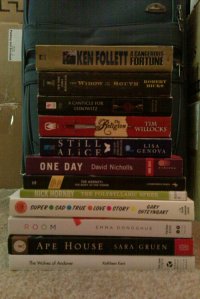
I usually select a whole pile of candidates, then cull until I think the final selection will provide enough variety and last me the whole trip without too much to spare. Here’s my candidate pile for my upcoming trip, which is a long one, with lots of plane time. It mostly consists of galleys I’ve been looking forward to reading (though they’re heavier) and mass market paperbacks I’ve been meaning to read and get rid of:

Travel Candidates 8/10From the top down, that’s:

“A Dangerous Fortune” by Ken Follett, which I’ve had forever;
“The Widow of the South” by Robert Hicks;
“A Canticle for Leibowitz” by Walter M. Miller, Jr.;
“The Religion” by Tim Willocks;
“Still Alice” by Lisa Genova;
“One Day” by David Nicholls;
“The Agency 02: The Body in the Tower” by Y.S. Lee;
“The Polysyllabic Spree” by Nick Hornby;
“Super Sad True Love Story” by Gary Shteyngart, which I’ve borrowed;
“Room” by Emma Donoghue;
“Ape House” by Sara Gruen; and
“The Wolves of Andover” by Kathleen Kent.

Two days to decide…let the deliberation begin!

On a happy note, I already have my audiobooks picked out: “Zeitoun” by Dave Eggers and the Moon Books trilogy by Susan Beth Pfeffer!

Thoughts on “To Kill a Mockingbird” by Harper Lee (Audiobook)

This year, as you may already know, marks the 50th anniversary of To Kill a Mockingbird by Harper Lee. I first read To Kill a Mockingbird back in eighth grade, but I tend to forget book plots. With all the talk going on because of the big anniversary, I decided to listen to the book to refresh my memory. When I began, I didn’t remember much of the story at all, beyond a few character names and some extremely vague plot points. It was almost like reading the book for the first time.

To Kill a Mockingbird by Harper Lee (audiobook cover)The book, set in Maycomb County, Alabama, during the depression, follows the Finch family: Scout (the daughter), Jem (her older brother), and Atticus (their father, a lawyer). The big event in the novel is the trial of Tom Robinson, a black man accused of raping a white woman. Around this centerpiece flows ordinary life in a small Southern town, populated with a colorful cast of characters and punctuated by the adventures of the children. “To Kill a Mockingbird” tackles big themes, but they are shown through a child’s eyes as Scout relates the events and her reactions to them in the first person.

The audio version I chose to listen to is read by Sissy Spacek, who does an phenomenal job bringing Scout and her adventures to life. Spacek’s accent is just right, her pacing easy, her characters clear and well differentiated. No drive seemed long while I was listening to her wonderful rendering of Harper Lee’s classic in my car. Hearing the story read so well brought it alive for me in a way I sometimes have to struggle to achieve when I read such books for myself.

If you’ve never read To Kill a Mockingbird, or if you’d like to read it again, I’d highly recommend getting your hands on a copy of the audiobook read by Sissy Spacek. What a great way to experience a great book!